

 Italiano
 Crystal Therapy Bracelet
World of Jewel
Moonstone for Jewelry: A Technical Guide for Jewelers and Brands
Nov
Moonstone is a feldspar (orthoclase and albite) with a Mohs hardness of 6–6.5 and perfect cleavage, which is why it is almost always cut as a cabochon and set in closed bezels. This guide brings together technical data, quality criteria, differences from labradorite and workshop guidance for jewelers, workshops and jewelry brands.
Moonstone technical data sheet
Moonstone belongs to the alkali feldspar group. Its optical effect, called adularescence, comes from alternating microscopic layers of orthoclase and albite that scatter light into a white-blue sheen.
| Property | Value |
| Composition | Feldspar (orthoclase KAlSi₃O₈ with albite) |
| Crystal system | Monoclinic |
| Mohs hardness | 6–6.5 |
| Cleavage | Perfect in two directions, at about 90° |
| Refractive index | 1.518–1.526 |
| Specific gravity | 2.55–2.58 |
| Birefringence | 0.005–0.006 |
| Luster | Vitreous, with adularescent sheen |
| Transparency | Transparent to translucent |
| Colors | Colorless, white, gray, peach, blue, green, brown |
| Most common imitations | Glass, labradorite sold as “rainbow moonstone” |
How to grade moonstone quality
In trade, value depends almost entirely on adularescence and clarity, not on the mineral species. Buyers purchasing for production should check five criteria, in this order.
| Criterion | What to look for | Effect on value |
| Adularescence | Intense blue sheen that moves and covers the whole surface, not just one spot | The main criterion: a sharp blue sheen on a colorless body is the most sought after |
| Transparency | Transparent or semi-transparent body, without uniform milky areas | The clearer the body, the deeper the sheen appears |
| Body color | Colorless, white, peach, gray: choose by end use and metal | A colorless body with a blue sheen is the most valuable |
| Inclusions | Small “centipede” fractures tied to the cleavage planes | Normal in small amounts: if they reach the edge, the risk of breakage during setting increases |
| Cut and orientation | Cabochon with the base parallel to the layers, even dome, sufficient thickness | Wrong orientation kills the sheen: it is the most common cutting mistake |
For multi-piece lots, check the stones under both diffused and point-source light: adularescence changes markedly with lighting.
Origins, varieties and imitations
The finest moonstones come from Sri Lanka, where they were once discarded in the search for rubies and sapphires. Other deposits are in India, Madagascar, Myanmar, Tanzania and Brazil. Each origin tends to give a different profile: Sri Lanka the transparent blue, India the white, peach and gray tones.
Moonstone and labradorite are not the same stone
The “rainbow moonstone” sold in trade is actually light-colored labradorite, a plagioclase with multicolored flashes (labradorescence), not the blue adularescence of orthoclase. For correct labeling in B2B catalogs, declare the species, for example “moonstone (feldspar)” or “white labradorite (rainbow moonstone)”.
Imitations and how to spot them
- Glass and opalite: no lamellar structure, bubbles are rounded and the sheen does not change when the stone is tilted.
- Natural stone: under a loupe you often see “centipede” fractures tied to the cleavage layers. They are a useful sign of authenticity.
For valuable lots, a check with a refractometer and specific gravity settles any doubt.
Moonstone formats available for production
The right format depends on what the workshop produces. The cabochon remains the reference cut because it shows off the adularescence and reduces the risk tied to cleavage.
| Format | Typical use | Working notes |
| Calibrated cabochon (round, oval, drop) | Rings, pendants, earrings in silver and gold | Standard sizes avoid custom bezel work: ovals from 6×4 to 14×10 mm and rrounds from 6 to 12 mm are the most requested |
| Free-form cabochon | One-of-a-kind pieces | Must be matched to the stone: the setting is built around it |
| Faceted | Sought-after cut for exclusive products | Needs careful cutting along the cleavage and protection in the setting |
| Tumbled | Bracelets, necklaces, pendants without bezel | Sheen is less intense than a cabochon, but cost is lower |
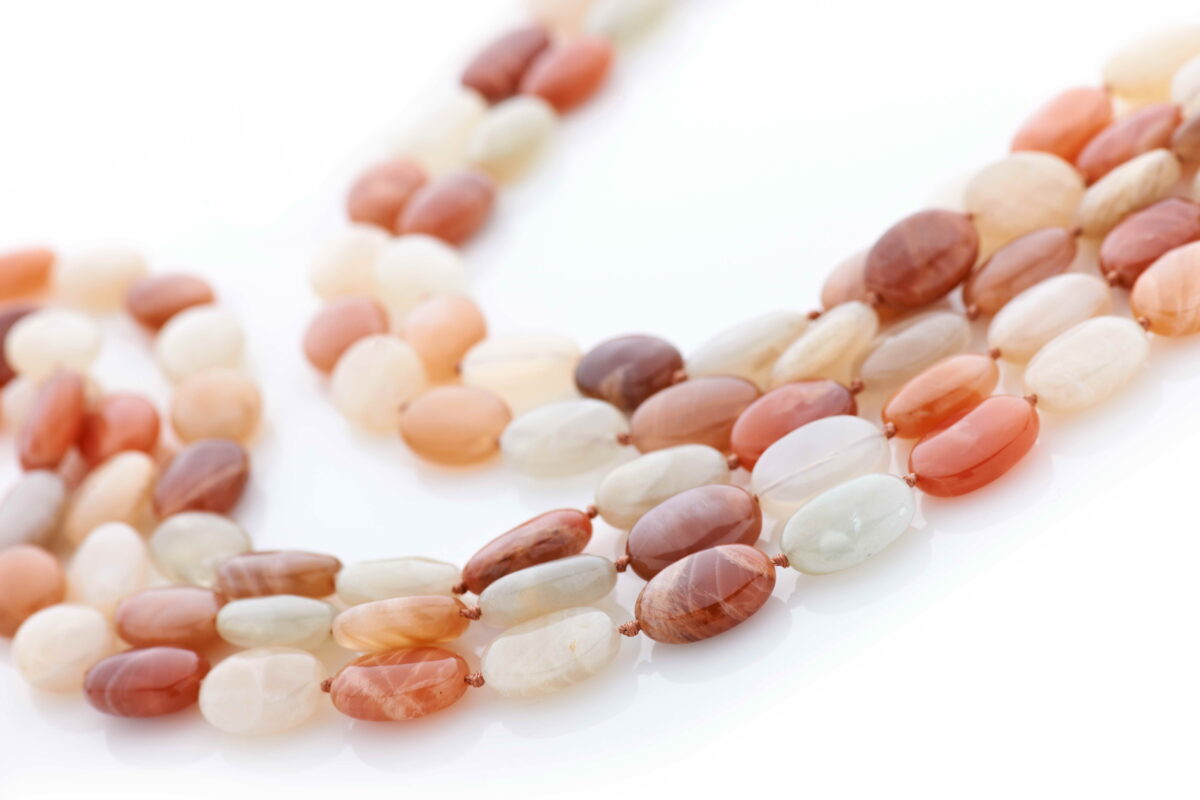
| Beads and other shapes | Necklaces, bracelets, strands | Drilling and silk-thread knotting reduce rubbing between beads |
| Rough | Lapidary workshops, collectors | Select by color and transparency before cutting |
Our B2B catalog includes both cabochons and strands in many cuts and sizes.
Setting and care in the workshop
The combination of 6–6.5 hardness and perfect cleavage makes moonstone delicate. A few rules cut the risk of breakage sharply.
- Closed bezel instead of prongs: it protects the edges from knocks and spreads the pressure.
- Rings: choose designs with a high, protected bezel. With daily wear the stone tends to scratch and chip.
- Pendants and earrings: the best settings, because the stone is less exposed to impact.
- Cleaning: lukewarm water and neutral soap. Avoid ultrasonic and steam cleaners, which can spread fractures along the cleavage.
- Heat: avoid thermal shock during soldering and polishing. Set the stone on the finished piece whenever possible.
- Acids and harsh solvents: avoid them when finishing a piece with the stone already set.
It helps to include a short care leaflet with each lot sold at retail, to hand to the end customer.
Moonstone FAQs for professionals
What is the hardness of moonstone, and can it be used in rings?
Moonstone has a Mohs hardness of 6–6.5 and perfect cleavage. It can be used in rings only with closed, protected bezels. For everyday wear, pendants and earrings are better suited.
Are moonstone and white labradorite the same stone?
No. Moonstone is an intergrowth of orthoclase and albite with a blue sheen (adularescence). Labradorite is a plagioclase with multicolored flashes and is often sold as “rainbow moonstone”: the correct species should be declared in the catalog.
How can you tell natural moonstone from an imitation?
The main signs are a moving sheen that changes as you tilt the stone, “centipede” fractures visible under a loupe, and gemological values (refractive index 1.518–1.526, specific gravity 2.55–2.58). Glass shows no lamellar structure.
Can moonstone be cleaned in an ultrasonic cleaner?
No. Ultrasonic and steam cleaners can spread fractures along the cleavage. Clean it with lukewarm water, neutral soap and a soft cloth.
Which origins produce the best moonstones?
Sri Lanka is the source of the finest stones, with a transparent body and blue sheen. India, Madagascar, Myanmar, Tanzania and Brazil supply material in different colors and qualities.
Do you supply wholesale moonstone for workshops and brands?
Yes, for professionals with a VAT number. On our website you can buy with no minimum order and with a wide range of formats available for immediate delivery. To see catalog prices, you need to create an account with your company details.
Discover our moonstone range
Discover our moonstone category in the web catalog
If you prefer, email quote requests to info@perlepietre.com
Perlepietre — gemstones and supplies for professional jewelry.

 +39 338 99 11 202